
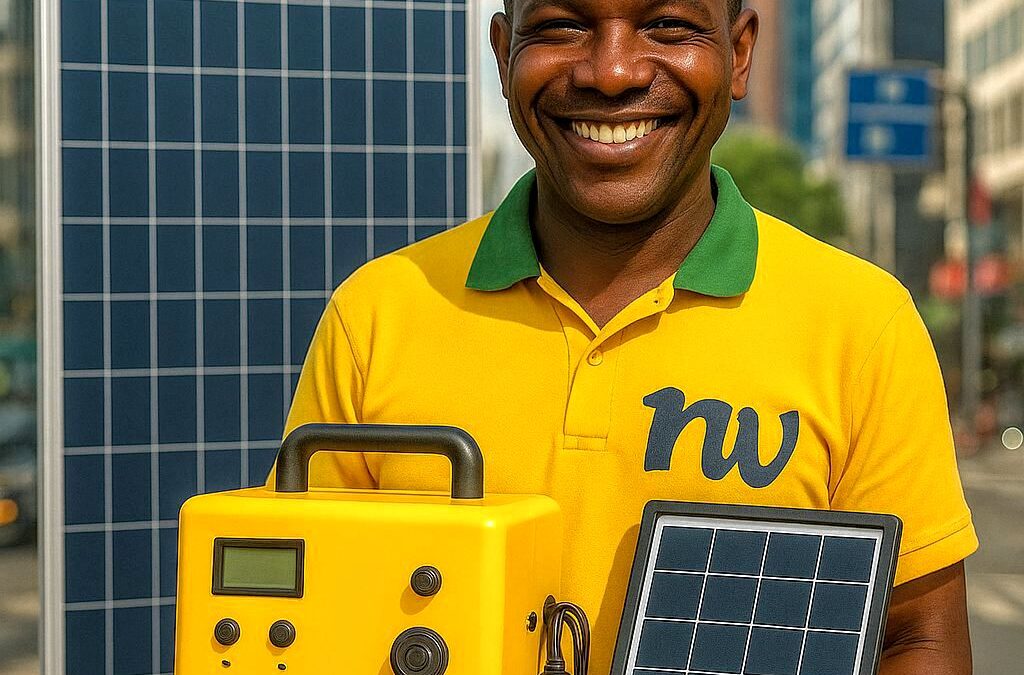
In Nigeria, where the hum of a generator is the national anthem of many households and businesses, a powerful business opportunity remains largely unseen. While discussions on power often revolve around government solutions or expensive inverter systems, a practical, community-focused venture is waiting to be seized. This is the business of renting small solar kits containing essential items like lights, phone chargers, and fans. For millions of Nigerians grappling with unreliable grid power, popularly known as “NEPA” or “Disco,” this service is not a luxury, it is a daily necessity.
This business is not what everybody is looking at now. Very few eyes are open to it. Yet it is a strong combination of what people need right now and what can grow into something big. If you pay attention and take action, you can build steady income from it. The idea is simple: buy small solar kits that include a panel, battery, lights, phone charging, maybe even a small fan, then rent them out weekly or monthly to families or small shops. You also help them maintain the kits.
Market Need: Why This Business Makes Sense in Nigeria
The demand for stable electricity in Nigeria is not just a need, it is a constant struggle that defines daily life.
- The Scale of the Problem: Nigeria leads the list of countries with the largest energy access deficit. According to the World Bank, over 85 million Nigerians, which is about 43% of the population, do not have access to grid electricity. For those who are connected, supply is often erratic, with many areas experiencing less than 12 hours of power per day. Each feeder experiences roughly 640 outages per year, equivalent to about 160 days without power for the average customer, that means people need alternatives now. (Energy for Growth Hub)
- The Cost of Alternatives: To cope, Nigerians and Nigerian businesses spend an estimated $14 billion annually on petrol and diesel for generators. This is a huge financial burden. The government and donors are pouring money into mini-grids and solar home systems, that makes private, small-scale solar services a commercially sensible play. (The Alliance for Rural Electrification+1) Your rental service offers a cleaner, quieter, and more affordable alternative to the expensive and polluting generator.
- The Communication Lifeline: In a country where mobile money and communication are vital, a dead phone can mean missed business opportunities and severed family connections. Your solar kit ensures customers can always stay connected, a value proposition that resonates deeply.
- Global and regional sales of solar energy kits are large and still growing, millions of units moved recently, that proves customers will accept and pay for packaged solar products when the price and payment model fit them. (org+1)
- Studies show the business opportunity for solar power and mini-grids in Nigeria is worth over 9 billion US dollars. That is huge. Worldwide, over 560 million people are already using off-grid solar solutions, and the number is still growing. This means renting solar kits has already worked in other countries, and here in Nigeria the need is even stronger.
Start Small, Test Demand
Do not rush to buy 100 kits immediately. First check your area. Walk around your neighbourhood or a local market. Talk to landlords, tenants, and shop owners. If you ask them how much they spend on buying petrol or small generators every week. Many spend thousands of naira. If 20 out of 100 people tell you they are ready to try a solar kit, you already have a green light to start.
Here is a quick market sizing logic to guide you: Use local observation, but these signals are real, Nigeria added tens of thousands of solar home systems and mini-grids in recent projects and donor programs, projects have reported selling over a million systems that reached millions of people, that shows demand is measurable at scale. (World Bank+1)
Choose the Right Kit
There are many solar kits out there. To keep things simple, start with two options:
- Basic Kit – One small solar panel, one battery, 2 to 4 LED bulbs, and a USB phone charger.
- Premium Kit – Bigger panel, stronger battery, one fan, 2 or more bulbs, and multiple USB ports.
Right now, good branded kits in Nigeria cost around ₦250,000 for models that come with a fan and panel. That is your cost to plan with. Before we do the math, let look at what a basic kit should contain and rough cost.
A community rental kit, targeted at lighting and phone charging with a small fan option, should include:
- 50W solar panel (or two 20W panels for redundancy)
- 12V deep cycle battery or lithium equivalent, 50–100 Ah depending on wattage
- Charge controller, wiring, mounting hardware
- 2 to 4 LED lights with wiring and switches
- 2 phone charging ports and simple DC outlet for a small fan
Retail panel and kit price examples in Nigeria show 20W to 50W panels from roughly ₦17,500 to ₦30,600, prices for full kits vary by components and battery chemistry. Use local suppliers like Kara, Jiji or direct wholesalers to lock price. Kara+1
Keep your business professional. Get basic tools like branded shirts, logbooks, and packaging materials for your solar rentals from trusted local platforms like Konga
Do the Maths
Let us break it down in simple numbers.
- If you buy one kit for ₦259,500 and rent it out for ₦5,000 per week, that is ₦20,000 in one month. Your money comes back in about 13 months.
- If you rent it cheaper at ₦3,000 per week, that is ₦12,000 in a month. Your money comes back in about 22 months.
- If you rent monthly at ₦10,000, you recover in about 26 months.
So payback time is between 13 to 26 months depending on your price. From then on, it is mostly profit.
Pick your Rental Style
You have three choices:
- Straight rental: Customer pays weekly or monthly, you keep the kit forever. You can rent to households and they pay via mobile money, POS or bank transfer. This is ideal for low-income customers who cannot afford upfront purchase. Use simple contracts and deposit where possible.
- Rent to own: They pay small deposits and regular rent until they fully own it.
- Pay-as-you-go (PAYG): Customers pay through mobile money, and the system locks or unlocks the kit depending on payment. This requires embedding remote metering and allows customers to top up credit via USSD or mobile money. The advantage of this is that it lowers theft and non-payment but needs tech and partnerships.
For a start, straight rental is easiest. Later you can add the pay-as-you-go option when you are big.
Start with a Small Fleet
Buy 10 kits first. This is enough to test the waters without tying down all your capital. You can handle 10 easily, manage the customers, and learn what works. If it goes well, add more. But while sourcing your kits, note:
Quality is Non-negotiable: Quality is critical to build trust and ensure longevity in the Nigerian environment. Look for reliable suppliers, preferably those with a presence in Nigeria to avoid customs issues. China is a major source, but also investigate suppliers from Ghana or Kenya who may already produce kits suited for West African conditions. Key components are: a 10W-20W solar panel, a durable power bank or small battery unit (e.g., 20,000mAh), an LED light bulb, a phone charging cable, and a small DC fan.
Durability and Safety: Nigeria’s climate, from the dust of the north to the humidity of the south, demands robust equipment. Kits must be able to withstand harsh weather. Ensure all components have necessary certifications to prevent electrical hazards. Provide instructions in simple English and major local languages.
Every serious solar rental service needs an online presence — not a fancy one, just a basic booking or information site customers can visit. You can host yours on a reliable and affordable platform like Truehost, which offers domain registration and hosting plans perfect for small startups.
Learn Maintenance from Day One
Solar kits are simple, but they need care. Batteries are the first to fail. So keep spares. For every 10 kits, have at least 2 spare batteries. Keep bulbs, wires, and simple tools too. Train one technician who knows how to fix small issues. Visit customers weekly at first to check things. Later, do it every two weeks. Write down problems and solutions for each kit, so you know the history.
Set the Right Price
This is a business; and in business, you want to make profit while you offer value. This is where the right price comes in solar rental kit. Your price must be cheaper than generator fuel. That is your selling point. If someone spends ₦500 a day on fuel, give them a solar kit that costs less. Offer one week free trial if you are targeting estates or compounds. People believe more when they see the kit working with their own eyes.
And for payment, use mobile transfers. Nigerians love WhatsApp, so use it to send reminders. Always give receipts. Even a handwritten receipt builds trust. For weekly rentals, remind customers a day before. Just be smart!
Get Customers Fast and Build your Small Team
As your business is taking off, do not waste money on big adverts. Go direct. Join estate WhatsApp groups. Show short videos of the kit charging phones and powering a fan. Do Saturday demos in compounds or markets. Give referral discounts. If one tenant likes it, others in the same house will want it. Partner with landlords, market women, and small shop owners.
At the beginning, you only need one technician and one delivery person. The technician installs and fixes. The delivery person carries kits, collects payments, and handles customers. In fact, to reduce operational cost, you can do the delivery yourself. But very important, you must have a technician, except you are a trained technician yourself. As the business grows, use an external accountant.
Ask customers to pay a small deposit. It covers theft or careless handling. Keep it affordable, not too high. Make them sign a simple agreement. Respond to complaints as soon as you can. Replace faulty batteries quickly. That’s how you win trust.
Grow to add more Systems
When you reach 60 to 70 percent usage of your kits every week, expand to another neighbourhood. Add more kits. Start offering to small shops, barbers, salons, and food sellers. They pay more because they need steady light. Later, you can supply schools or clinics.
As you begin to expand and reach 50 or 100 kits, you might start considering bringing in more complicated systems. Don’t forget, you don’t need these systems in the beginning. Bring in pay-as-you-go controllers. They allow you to switch the kit on or off remotely when customers delay payment.
Funding and Partnerships
As your business begins to grow and demand increases, you might need extra funding. Until then, start with your own money or support from family. Once you prove the business, go to microfinance banks or impact investors. There are World Bank programs and donor projects already supporting solar businesses in Nigeria, and they can help you scale.
Watch Your Numbers
Track these every week:
- How many kits are in use.
- How much you earn per kit monthly.
- How many times a kit breaks down.
- How many customers stop renting.
- How long it takes to recover your money per kit.
If you ignore numbers, you are walking blind.
Mistakes to Avoid
- Do not buy very expensive kits before you test demand.
- Do not ignore maintenance, customers will leave fast.
- Do not joke with collections, unpaid rent kills the business.
- Do not rush into tech before your business is stable.
To get moving, this is summary of what you should do:
- Pick one neighbourhood and ask people if they want solar.
- Buy 10 kits, mix of basic and premium.
- Train one technician, hire one rider, open a WhatsApp Business account.
- Set fair prices, offer one-week demo.
- Keep spare parts ready.
- Track all payments, repairs, and rentals weekly.
This is not a get-rich-quick scheme. But it is steady money, steady growth, and a future business that can expand into bigger solar projects. The demand is real, the numbers are strong, and very few people are paying attention now. If you start early, you can build trust, scale slowly, and position yourself as a leader in a market that will only keep growing.
The beauty of building a small rental business like this is freedom — freedom to grow, travel, and explore opportunities. Platforms like Wakanow make that easy when you’re ready to take your success beyond borders
____________________________________________________________________________________________
TOP PICK RESOURCE FOR YOU
If you are tech person, here is a great ebook (pdf) that will teach you step by step on how to start your own business with no money. All you need is strong desire and a laptop with internet connection. You may like this. You can get it here.
CONNECT TO TOP-RATED SOLUTION FOR YOUR PERSONAL NEEDS
Explore My Top-Rated Resources | Explore Exclusive Travel & Hotel Deals
Discover Health & Wellness Essentials____________________________________________________________________________________________
Disclosure: This page contains affiliate links. If you make a purchase through these links, I may earn a small commission at no extra cost to you
____________________________________________________________________________________________